IASP Sophia Antipolis Training Seminar: building the skills to develop successful innovation spaces
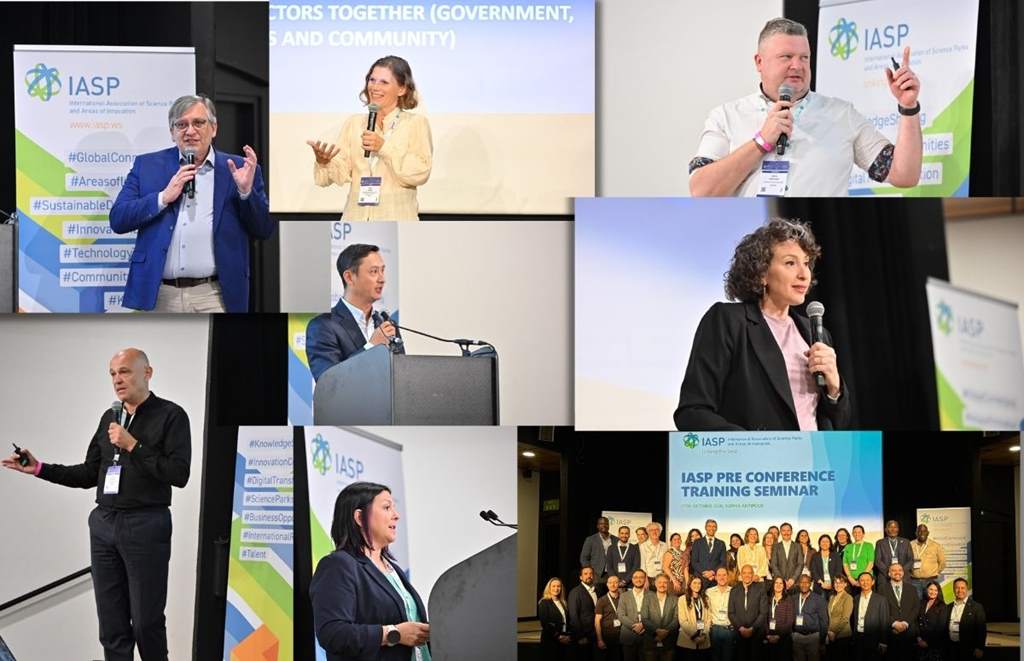
On 27 October, just before the 43rd IASP World Conference got under way, delegates new to our industry or looking to build on their knowledge gathered at the Palais des Festivals et des Congrès de Cannes for our annual training seminar. The one-day programme covered the fundamentals of science and technology parks (STPs), innovation districts (IDs) and areas of innovation (AOIs), with seven speakers each addressing a key building block that any new project needs to get right.
Setting the scene: models and innovation districts
IASP CEO Ebba Lund opened the day with an overview of the different models of innovation spaces. She highlighted how STPs, IDs and AOIs coexist in innovation ecosystems across the globe, highlighting the wealth of synergies and collaborations that we can build on from our common mission. She also explored the building blocks of the Science and Technology Park model, using the seven axes of the IASP Strategigram to illustrate how their missions and roles have evolved over time.
The focus then shifted to innovation districts with Luiz Carlos Pinto da Silva, Secretary of Innovation for the city of Porto Alegre and leader of the 4th District innovation district. He explained how districts develop through collaboration between city governments, universities, companies and local communities. His session also covered concepts such as the hybrid use of space and the integration of work, living, leisure and culture. His advice to those developing new districts was to start with what is already there before deciding on a model: the land, anchor institutions, companies and local community.
Business creation and services
Derya Çağlar, CEO of Ostim Teknopark, led the session on business incubation and business creation. Drawing on Ostim Teknopark's experience of building synergies between parks and incubators, she focused on the hard decisions managers need to make to support entrepreneurs effectively. She shared practical examples, top tips and twelve habits for managers, emphasising that “the right entrepreneur should receive the right intervention, at the right moment, for the right amount of time”.
Ming Yang, Vice President and Secretary to the Board of Directors of TusHoldings, then examined the services innovation spaces should provide at different stages of a company's development. His message was that a park creates value not simply by renting out space, but by delivering a comprehensive service system. Using TusPark as an example, he walked participants through a six-step ladder that takes founders from student entrepreneurship courses all the way to a stock market listing. This pathway is backed by an “incubation + investment” model with more than 80 funds covering stages from seed investment to M&A.
Marketing and communication
Martin Goroško, Head of Business Development at Tallinn Science Park Tehnopol, explored marketing and communication in the AI era. He looked at how an integrated strategy can help innovation hubs attract companies and talent while maintaining their relevance to stakeholders, resident companies, civil society and decision-makers.
Findings from the IASP Global Survey 2024 showed that strong branding and the quality of resident companies were equally important factors in competitiveness, ranking just ahead of the prestige of universities. Martin used these findings to show how a park's brand, its companies and its universities contribute to one another's reputation. His practical advice was to choose the target audience before the communication channel, and to let resident companies help tell the story of the services on offer. He also stressed the importance of consistency and encouraged parks to use AI as a supporting tool without allowing it to talk directly to their audiences.
Collaboration and governance
Effective stakeholder engagement and well-designed governance are fundamental to the development of any innovation ecosystem. Jenn Dawe, Manager of the David Johnston Research + Technology Park at the University of Waterloo, explored how partnerships between innovation spaces and universities can drive research and entrepreneurship, connect academia with the market and attract talent.
In a session entitled “A Tale of Two Incubators”, she explained how Waterloo came to develop two very different incubators. The Accelerator Centre was founded in 2006 as an independent not-for-profit organisation supporting companies in commercialising and scaling their businesses. Velocity followed in 2008 as the world's first entrepreneurial residence for students. Rather than competing, the two have become a defining complementary strengths of the Waterloo ecosystem.
Roland Sillmann, CEO of Berlin Adlershof, closed the programme with a session on governance and stakeholder management. He examined the institutional structures behind innovation spaces and how these need to evolve as projects develop. Building on Richard Florida's three Ts of technology, talent and tolerance, he introduced two additional elements, team and trust, to create a 5T-framework, with a key governance question attached to each. He illustrated the framework with insights drawn from more than ten years of experience as CEO at Adlershof.
The IASP Training Seminar provides an opportunity for professionals starting out in STPs, AOIs and IDs to gain practical tools, learn from the experience of their peers and build the connections they need to build successful, sustainable projects. Our thanks go to all the speakers and participants for their time, their questions and their contributions throughout the day.