/)



Question of the Month: Talent recruitment challenges reveal skills gap
/Question_of_the_month_June_2026.png)
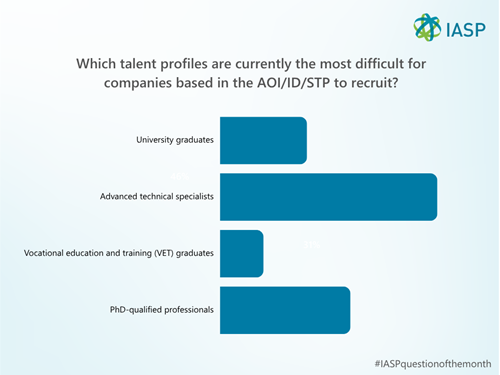
This month, we asked our members which talent profiles are currently the most difficult for companies based in areas of innovation, innovation districts and science and technology parks to recruit. The results provide valuable insight into the talent challenges facing innovation ecosystems globally.
"Advanced technical specialists" emerged as the most challenging talent profile to recruit, with 50% of respondents identifying this as a significant difficulty. This was followed by PhD-qualified professionals, cited by 30% of respondents, and university graduates, mentioned by 20%. Vocational education and training (VET) graduates were identified as a recruitment challenge by 10% of respondents.
The prominence of advanced technical specialists in the responses suggests a critical mismatch between what companies need and what is available. As innovation ecosystems increasingly focus on deeptech, artificial intelligence, biotechnology and other specialised fields, demand for professionals with advanced technical expertise continues to outpace supply. This challenge is particularly acute because such specialists often require years of highly specialised training and experience, making them difficult to source quickly.
The difficulty in recruiting PhD-qualified professionals also merits attention. As research commercialisation and technology transfer have become increasingly important in science park operations, the need for researchers who can bridge academic research and industry application has grown. Yet, the pipeline of PhD graduates willing or able to transition into industry roles remains constrained.
These results underscore a broader reality for innovation ecosystems: talent development and attraction remain critical bottlenecks to growth. Science parks and innovation spaces cannot succeed without addressing the supply of skilled professionals. This may require closer collaboration between educational institutions and industry, investment in reskilling and upskilling programmes, and targeted strategies to attract and retain advanced talent. The findings suggest that innovation spaces should prioritise talent as strategically as infrastructure and financing.


/canvascolor(0xffffffff)/2023_07_14_Saudi_Arabia_LAB7_Aramco.png)
/canvascolor(0xffffffff)/Korea_Innovation_Foundation.png)
/canvascolor(0xffffffff)/2018_10_31_Canada_Quebec_International.png)
/canvascolor(0xffffffff)/PPPT_pion_logo_CMYK_L_(003)_3.jpg)
/canvascolor(0xffffffff)/Captura_de_tela_2025-03-06_122825.png)
/canvascolor(0xffffffff)/gcid-logo_logo-colour_for_web_with_20__2.jpg)
/canvascolor(0xffffffff)/tps.JPG)
/canvascolor(0xffffffff)/MemberLogo-5652-6081.jpg)
/canvascolor(0xffffffff)/2017_11_15_Slovekia_CEPIT.jpg)
/canvascolor(0xffffffff)/OPENZONE_1.jpg)
/canvascolor(0xffffffff)/2026_09_25_Germaing_Wista_Berlin_Adlershof.jpg)
/canvascolor(0xffffffff)/MemberLogo-36401-6008.png)
/canvascolor(0xffffffff)/2026_03_12_India_AMTZ.jpg)
/canvascolor(0xffffffff)/2025_09_16_Sweden_Medeon_SP.png)
/canvascolor(0xffffffff)/footerLogo_5.png)
/canvascolor(0xffffffff)/V_1.jpg)
/canvascolor(0xffffffff)/logo-oscuro-parque-cientifico-ua.png.png)
/canvascolor(0xffffffff)/Norwich_Research_Park_Logo_artwork_transparent_bg_4.png)
/canvascolor(0xffffffff)/logo_21.png)
/canvascolor(0xffffffff)/2026_03_12_Brazil_TECCNOPUC.png)
/canvascolor(0xffffffff)/DSP_logotyp_svart_png.png)
/canvascolor(0xffffffff)/MemberLogo-5769-6232.jpg)
/canvascolor(0xffffffff)/healthcampus_logo_notext_transparant_7.png)
/canvascolor(0xffffffff)/Logo_UO_4.jpg)
/canvascolor(0xffffffff)/NU_STeP_logo_2.PNG)
